Inspect an aluminium cladding delivery against the purchase order, approved submittals, package list, current drawings and finish references before releasing it for storage or installation. Record package identity and quantity, visible transport damage, moisture, deformation, edge and finish condition, missing or mixed components, protective covering and the proposed storage location. Quarantine anything unidentified or damaged until the responsible project parties issue a documented disposition.
A delivery inspection confirms what arrived and its visible condition at a specific time. It does not approve concealed engineering, panel performance, coating durability, installation suitability or project compliance. Those decisions remain with the project specification, approved system, manufacturer’s written instructions and responsible design and quality teams.

Build the receiving check around controlled documents
Do not inspect the truck against memory or a screenshot from an old email. Assemble the current purchase order, approved material or finish references, package list, delivery note and the drawing or panel schedule used for release. Mark the revision of each document in the receiving record.
The delivery note may identify packages and quantities, but it does not by itself prove that the contents match the approved project information. The receiving team should be able to trace each inspected package to the expected panel group, accessory group or drawing zone without inventing a supplier-specific label format.
The site’s Capabilities & Process page explains the route from project brief to confirmed evidence and enquiry. The aluminium cladding page covers panel proportions, returns and finish direction. This checklist starts later—when a project delivery reaches the site—and does not define the product specification.
Use one delivery inspection register
| Receiving check | What to record | Hold point or next action |
|---|---|---|
| Delivery identity | Supplier or shipper reference, vehicle/container reference, date, time and receiving area | Stop if the delivery cannot be matched to the expected consignment. |
| Document revision | Purchase order, package list, approved submittal, drawing and finish reference revisions | Resolve conflicting or superseded documents before release. |
| Package identity | Package number, panel group or zone, label condition and any orientation/sequence mark | Quarantine packages with missing, illegible or conflicting identity. |
| Quantity and package count | Expected and received packages, declared contents and visible shortages | Record the variance; do not silently amend the delivery note. |
| Packaging condition | Tears, punctures, broken restraints, displaced supports or opened wrapping | Photograph before handling and inspect the affected area more closely. |
| Moisture and contamination | Wet wrapping, trapped water, staining, dust, oil, metal debris or other contamination | Isolate the affected package and obtain a documented response. |
| Shape and edges | Bending, twisting, buckling, dents, crushed corners, chipped edges or distorted returns | Do not release affected panels for installation pending disposition. |
| Visible finish | Scratches, abrasions, colour/texture concern, damaged protective film or handling marks | Compare only with the controlled finish reference and agreed viewing basis. |
| Accessories and interfaces | Trims, closures, brackets or other listed items; package identity and condition | Record missing, mixed or damaged accessory packages separately. |
| Storage readiness | Base/support, cover, ventilation, drainage, access, segregation and protection plan | Move only to a prepared location consistent with project and manufacturer instructions. |
| Decision and handover | Accepted, accepted with recorded reservation, or quarantined; owner and next review | Release only the identified unaffected scope; keep the rest segregated. |
This register is a traceability tool, not a universal acceptance standard. Project-specific criteria and competent site procedures control the actual decision.
1. Record the arrival before handling changes the evidence
Photograph the overall delivery, package arrangement, restraints, wrapping and visible impact areas before unloading or opening. Include the delivery reference and location in the photo log without exposing confidential shipping data in public records.
Note whether packages have shifted, supports have collapsed, wrapping has torn or water is present. If a package is unsafe to handle, stop and follow the site’s approved lifting and logistics plan. This article does not prescribe lifting points, equipment, crew size or unloading sequence.
The first record matters because later movement can make it difficult to distinguish transport damage from unloading or storage damage. Keep the carrier or delivery representative’s acknowledgement separate from technical acceptance of the panels.
2. Match packages to the approved release information
Check package numbers, panel marks, elevation zones, finish references and accessory group references against the controlled package list or panel schedule. The exact marking system is project-specific. If orientation or installation sequence affects the work, preserve the mark used to communicate it.
Count packages first, then use the declared contents and agreed sampling or opening plan to verify what is inside. A closed package count cannot prove the quantity or condition of every panel. Conversely, opening every package without a protection and resealing plan can create new exposure and traceability problems.
Separate quantity variance from identity variance. A short delivery, an extra package and a package with the wrong mark require different records. Do not relabel an unidentified package locally unless the responsible party confirms the identity and the change is traceable.
3. Inspect packaging, moisture and contamination
Look for punctured or torn wrapping, crushed package edges, broken straps, displaced blocks or supports, wet coverings, standing water, condensation, dirt, oil and metal fragments. Record what is visible without assuming what happened during transport.
Where moisture is present, identify whether it is outside the covering, trapped within a package or in contact with the panel surface. Do not state that drying alone makes the material acceptable. The finish, protective film, packaging system and manufacturer instructions determine the appropriate response.
Keep packages away from materials or activities that could stain, dent, scratch or contaminate the panels. Grinding debris, wet trades and uncontrolled traffic are examples of site conditions to review, not proof of a particular failure mechanism in every project.
The current UFGS 07 42 63 Fabricated Wall Panel Assemblies is a U.S. Department of Defense guide specification, not a UAE or Saudi delivery standard. It is used here only as a documentation example: its delivery section calls for packages and handling that avoid deformation and surface damage, and for dry, covered, ventilated storage that drains water and avoids contact likely to stain or dent the panels.
4. Check shape, edges and visible finish separately
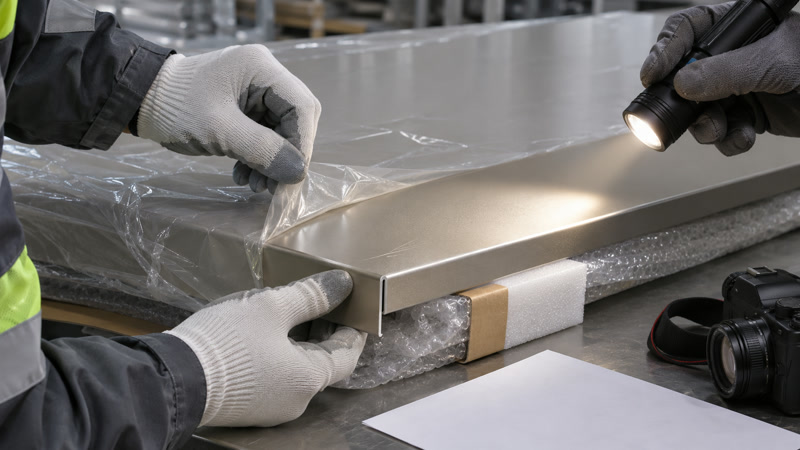
Use a wider view to look for bending, twisting, buckling or a package that no longer sits as expected. Then inspect accessible edges, corners, returns and finished faces under suitable light. A clean outer wrapper does not prove that every panel inside is undamaged.
Record dents, crushed corners, chipped edges, scratches, abrasions, coating damage, embedded debris and disturbed protective film by package and panel reference where possible. Do not use a general note such as “minor damage” without location, extent, photographs and the proposed decision route.
Compare colour, gloss or direction only with the controlled sample or approved range and under recorded viewing conditions. Delivery inspection is not the place to create a new finish tolerance. If the issue needs a larger sample or installed comparison, move it to the appropriate sample or mock-up review process.
5. Quarantine first; decide repair or replacement through a controlled route
Clearly separate unidentified, wet, deformed, visibly damaged or disputed material from accepted packages. Mark the hold in the receiving register and storage map. Physical segregation should be obvious to the site team without adding a label that falsely identifies the product.
Request a documented disposition from the party defined by the project quality plan. The response may call for further inspection, cleaning, a repair trial, replacement, acceptance within the project criteria or another action. Do not treat a driver’s comment, an informal message or a delivery-note signature as technical approval.
If repair is proposed, identify the exact panel, defect, method, materials, responsible party and re-inspection requirement. Acceptance of one repair sample should not become approval for every scratch or dent. Retain before-and-after photographs and the final decision.
UFGS 07 42 13, another U.S. guide specification, is used only to illustrate this separation of states. Its construction-monitoring section checks whether materials are stored, handled and protected from damage, while its finish-repair section distinguishes acceptable repairs from surfaces that require removal and replacement. The project’s own requirements control the actual decision.
6. Prepare the storage area before accepted packages move
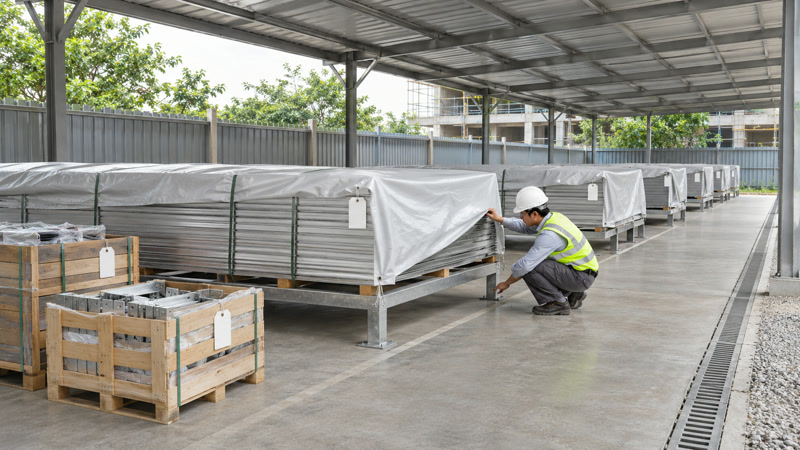
Confirm that the storage location has a stable prepared base or support arrangement, suitable cover, ventilation, drainage, access for inspection, segregation from damaging activities and a route that does not force repeated unnecessary handling. Follow the approved logistics plan and manufacturer’s written storage instructions.
Do not invent a universal stacking height, support spacing, slope, cover material or maximum storage period. These depend on the package design, panel geometry, finish, environmental conditions, lifting method and written project information.
Weather protection should not trap water or condensation. Keep accepted packages identifiable and accessible enough for periodic checks. If the storage arrangement changes, update the map and record who authorised the move.
7. Protect sequence, orientation and accessory traceability
An accepted panel can still become difficult to use if its identity or sequence is lost. Keep package and panel marks legible, protect orientation references, and preserve the connection between panels, trims, closures and other listed accessories.
Do not mix visually similar accessories from different zones or revisions without a controlled check. Keep small components in identified packages and record partial issues from a package. A package that has been opened should have a resealing or protection action and a remaining-quantity record.
Protective film needs its own status. Record damage, peeling, contamination or trapped moisture and follow the manufacturer’s written instructions for retention and removal. A generic article cannot establish a safe removal deadline for an unknown film and finish system.
8. Close the receiving record before installation release
The final receiving record should show what was accepted, what was accepted with a reservation, what remains quarantined and what is missing. Attach the package map, photographs, delivery note, variance list and disposition references. Name the person or role responsible for each open action and the evidence required to close it.
Release only the identified unaffected material. If one package is disputed, do not let the status of the entire delivery become ambiguous. Update the installation team when a hold is added or removed, and keep the storage record current until the material is issued.
Copy-ready receiving record
Adapt this wording to the project:
Delivery [reference] arrived at [location] on [date/time] and was checked against purchase order [revision], package list [revision], approved submittal/finish reference [status] and drawing or panel schedule [revision]. Package identity, count, visible packaging condition, moisture/contamination, deformation, edges, finish and accessory groups were recorded before release. Accepted packages are shown on the attached storage map. Items listed as quarantined or short must not be issued for installation until the named disposition and re-inspection requirements are closed. This receiving record confirms visible condition and traceability only; it does not replace project compliance, performance or installation approval.
Red flags at the receiving area
- The delivery is checked against an obsolete drawing or package list.
- Packages have no readable identity or their marks conflict with the delivery documents.
- The delivery note is signed before visible damage and shortages are recorded.
- Torn or wet packaging is moved directly into general storage without inspection.
- Bent, dented or scratched panels are described only as “minor damage.”
- Finish concerns are judged from memory or a phone image rather than the controlled reference.
- Unidentified material is locally relabelled without a traceable decision.
- Accepted and quarantined packages share the same unmarked storage area.
- Covering traps moisture or prevents periodic inspection.
- Protective film condition and manufacturer instructions are not recorded.
- Repair is approved informally without a sample, method or re-inspection point.
Frequently asked questions
Does signing the delivery note mean the panels are technically accepted?
Not necessarily. A delivery signature may acknowledge receipt, while technical acceptance depends on the project’s inspection and quality process. Record shortages and visible reservations at receipt, then keep disputed material quarantined until a documented decision is issued.
Should every package be opened on arrival?
Use the project’s agreed inspection and sampling plan. Opening can reveal concealed condition, but uncontrolled opening can also expose panels, break traceability or make protection difficult. Record what was and was not inspected.
Can a scratched panel be repaired on site?
Do not assume so. The response depends on the finish system, defect, approved repair material, appearance criteria and project requirements. Obtain a documented method and re-inspection decision for the specific panel.
How long can aluminium cladding remain in site storage?
There is no universal duration. Follow the package and finish manufacturer’s written instructions, project logistics plan and actual environmental conditions. Inspect stored packages periodically and record any change in covering, moisture, support or condition.
For system context, review aluminium cladding. For façade coordination, see exterior aluminum panels and Capabilities & Process. When the project drawings, quantities, location and delivery requirements are ready, submit a project enquiry.
Reference sources
- WBDG: UFGS 07 42 63 Fabricated Wall Panel Assemblies — used only as an example of protecting metal wall panels from deformation, surface damage, moisture and damaging contact during delivery and storage.
- WBDG: UFGS 07 42 13 Metal Wall Panels — used only as an example of construction monitoring, damage protection and controlled review of finish repairs.
These sources illustrate receiving and storage questions. The actual purchase order, project specification, approved submittals, manufacturer instructions, quality plan and site safety/logistics requirements determine the applicable process.