A solid aluminium panel is formed from aluminium sheet and does not contain a bonded core. An aluminium composite panel (ACP), also called aluminium composite material (ACM), has metal skins bonded to a core. The two constructions can look similar after finishing, so a photograph or the phrase “aluminium cladding” is not enough to identify what is being quoted.
Before comparing prices, make every bidder name the panel construction and connect it to the same drawings, finish requirements, samples and performance documents. This guide explains how to do that without assuming that one material is automatically suitable for every facade.
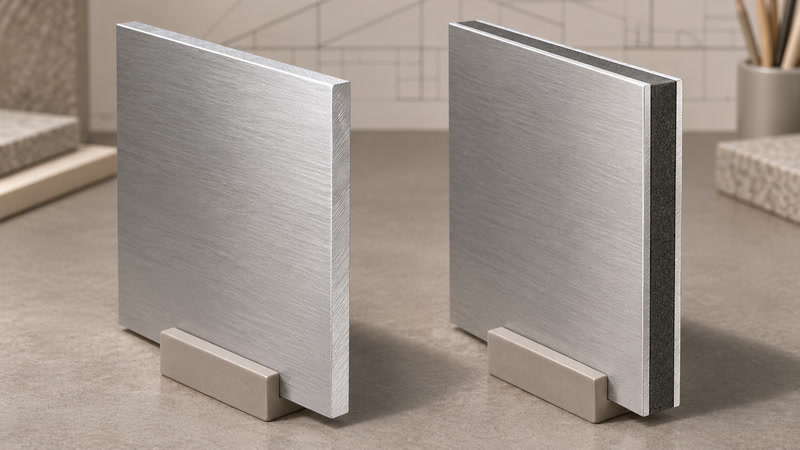
Start with the construction, not the appearance
The Aluminum Association describes aluminium sheet as a rolled product. In a solid-panel cladding enquiry, the panel should therefore be identified as formed aluminium sheet, with the project specification stating the required alloy, temper, thickness and finish where those values have been approved.
The Metal Construction Association and the International Code Council define metal composite material (MCM) as a factory-manufactured panel with metal skins bonded to both faces of a solid plastic core. ACM is the aluminium-skinned form of that composite material. The word “composite” describes the construction; it is not simply another spelling for a solid aluminium panel.
Neither construction can be approved from a generic name alone. The selected product, panel build-up, attachment method and supporting wall assembly must match the project documents and the requirements of the authority and design team responsible for the building.
Why cladding quotations are easily misread
“Aluminium cladding” can describe the visible facade use rather than the material build-up. A drawing title, BOQ line or supplier quotation may use that broad phrase while leaving the construction unclear. Similar colours and joint layouts can make the finished surfaces look alike in a rendering.
Three ambiguities cause most review problems:
- The document lists only an overall panel thickness but does not state whether that dimension is a single aluminium sheet or a composite panel.
- The finish name is prominent, while the substrate, core and exact product identification are missing.
- A sample or photograph is submitted without a label that connects it to the quoted product, drawing revision and supporting technical documents.
Resolve these points before treating two prices as comparable.
Use the same six checks for every quotation
| Check | Solid aluminium panel | ACP / ACM | What the reviewer should confirm |
|---|---|---|---|
| Material construction | Formed aluminium sheet without a bonded core | Aluminium or other metal skins bonded to a core | The construction is written explicitly, not inferred from “cladding” or a photograph. |
| Product data | Approved sheet alloy, temper, thickness, finish and forming details where applicable | Manufacturer, product designation, skin material, core type, overall thickness and finish | The data sheet identifies the same product offered in the quotation. |
| Drawings | Sheet thickness, returns, folds, stiffening or attachments as designed | Composite panel build-up, routed/folded edges, joints and attachments as designed | Sections and details match the material construction and quoted scope. |
| Sample | Labelled solid-sheet sample or formed sample tied to the finish reference | Labelled composite sample showing the quoted product and finish | The sample reference appears in the submittal register and approval record. |
| Performance documents | Reports and declarations for the proposed solid panel or relevant assembly | Reports and declarations for the exact composite product and relevant assembly | The product, assembly, test scope and project requirement can be traced to one another. |
| Alternatives | Any alternative is separately identified | Any alternative is separately identified | A substitution is not hidden inside a generic description or lower price. |
This table is a document-control tool, not a performance verdict. Project requirements and applicable rules still determine which evidence is necessary.
1. Lock the material name in the specification and RFQ
Use an unambiguous base description. If the design calls for solid aluminium sheet panels, say so. If it calls for ACP/ACM, name the composite construction and the exact product information the project team requires.
Avoid using “aluminium panel”, “metal panel” or “aluminium cladding” as the only material description. Those terms may be useful category names, but they do not establish the build-up.
Where the project allows an alternative, request it as a separate option. The bidder should state the change, affected details, supporting documents and price difference rather than silently replacing the base construction.
2. Make the drawings reveal the build-up
Plans and elevations show where panels go, but sections and details should show what the panels are. Ask for a typical panel section and at least the relevant edge, return, joint, opening and attachment details. The notes should agree with the specification and panel schedule.
For a solid sheet panel, the details should identify the sheet and the formed geometry required by the design. For ACP/ACM, the detail should identify the composite build-up and the panel fabrication relevant to the proposed system. Do not copy a detail from one construction into a package for the other without a project-specific design review.
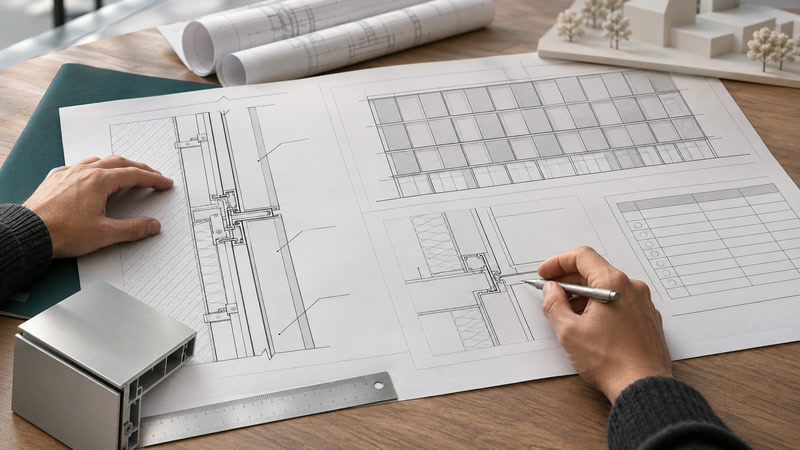
3. Trace the data sheet and sample to the quotation
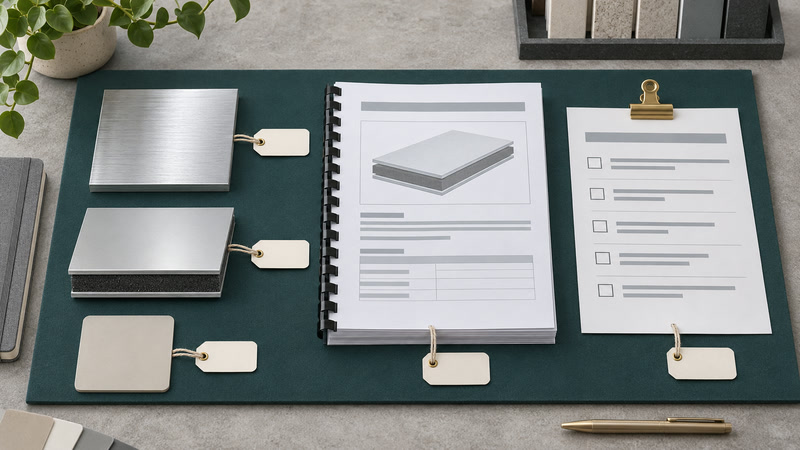
The quotation, product data sheet, sample label and submittal register should use the same manufacturer and product designation where a proprietary product is proposed. For a non-proprietary solid sheet specification, the submission should still identify the material and finish required by the approved documents.
Record the drawing revision and sample reference used for pricing. A colour chip without a product label can help discuss appearance, but it cannot prove the panel construction. Likewise, a facade photograph is a design reference, not evidence of the material behind the finish.
4. Review compliance evidence by product and assembly
Do not accept a detached certificate or test report simply because the file contains the word “aluminium”. Check the named product, construction, thickness or configuration, finish where relevant, test standard, test specimen or assembly and report validity. Then compare that scope with the project requirement.
Building rules vary by jurisdiction, building type, height, use and wall assembly. The ICC’s educational material, for example, regulates MCM as a specific material and system rather than treating every metal-faced panel as interchangeable. For a UAE or Saudi Arabia project, the project consultant and relevant authority should confirm the governing requirements and the evidence needed for the proposed facade assembly.
This step does not mean that solid aluminium automatically passes every requirement, or that every ACP/ACM product has the same performance. It means the approval decision must follow the exact product and assembly evidence.
5. Compare quotations on one controlled scope
Before comparing totals, issue the same document register to each bidder. Align the panel schedule, drawing revisions, finish reference, sample status, requested documents, included components, packing, delivery basis and exclusions.
Ask each bidder to list assumptions and deviations. A quotation that includes supporting components, special packing or additional documentation is not directly comparable with one that excludes them. First normalise the scope; then evaluate price and programme.
Copy-ready RFQ wording
Adapt this wording to the approved project specification:
Base quotation: price the panel construction stated in the issued specification and drawings. Identify whether the offer is for solid aluminium sheet panels or ACP/ACM, and state the exact material or product designation. Do not substitute a different construction unless it is submitted as a separately identified alternative. List all deviations, assumptions, exclusions and supporting documents, and confirm the drawing revisions used for pricing.
Add project-specific values only when they have been approved. Do not invent a thickness, alloy, core, finish system or performance rating to make the RFQ look complete.
Red flags to resolve before approval
- The quotation says only “aluminium cladding” or “aluminium panel”.
- The thickness is listed without a material build-up.
- The data sheet and quotation use different product names.
- The sample is unlabelled or cannot be traced to the finish and product offered.
- A report covers another product, construction or assembly.
- The bidder changes the construction without listing it as an alternative.
- Drawings, BOQ and specification use conflicting terms.
- A rendering or project photograph is treated as proof of material construction.
Any one of these issues warrants clarification. It does not by itself prove that the offered product is wrong; it shows that the submission is not yet controlled well enough for a reliable comparison.
Frequently asked questions
Is ACP the same as a solid aluminium panel?
No. ACP/ACM is a composite construction with metal skins bonded to a core. A solid aluminium panel is formed from aluminium sheet without that bonded core.
Can I identify the construction from a facade photograph?
Not reliably. Similar finishes, joints and lighting can hide the build-up. Use the specification, section details, product data and labelled sample.
Does the overall thickness identify the panel type?
No. A dimension without the build-up is ambiguous. Ask whether it refers to one aluminium sheet or to the total composite panel, and verify the answer in the data sheet and drawings.
Is one construction always better for fire safety?
Do not approve either construction from a generic category claim. Review the exact proposed product, facade assembly, test evidence and the requirements that apply to the specific project.
What should I send for a quotation?
Send the current specification, elevations, sections, panel schedule, finish reference, required documentation, quantities, location and delivery scope. Mark unresolved decisions and ask the bidder to state assumptions.
For broader facade planning, use the aluminium cladding design guide. To review the system page, see aluminium cladding. When your controlled document package is ready, submit a project enquiry with the project location, application, quantities and current drawings.
Reference definitions
- The Aluminum Association: Processing 101 — rolled aluminium sheet production.
- Metal Construction Association: Understanding Metal Composite Material — MCM construction and terminology.
- International Code Council: 2021 IBC Exterior Wall and Opening Protection — MCM definition and the need to assess the material as part of a regulated wall system. Local project requirements must be confirmed separately.